


Thai Agricultural Produce Market
The issue of ‘Food safety’ has become Thai Government’s national focus on 2004 when the government declares it to be ‘The Year of Food Safety’. In collaboration with various organizations in public sector, universities, and international community, Thai government establishes ACFS as international standard Bureau for organic agriculture accreditation and export as well as issues accredited food certificates such as Healthy Market, Clean Food Good Taste. On provincial level, the government encourages local administrations to control agriculture production within their own areas in accordance with ACFS standards. The policy has been carried out by establishment of numerous local accreditation offices which operate as quality control unit and information distribution center to make farmers conscious of growing safe food.
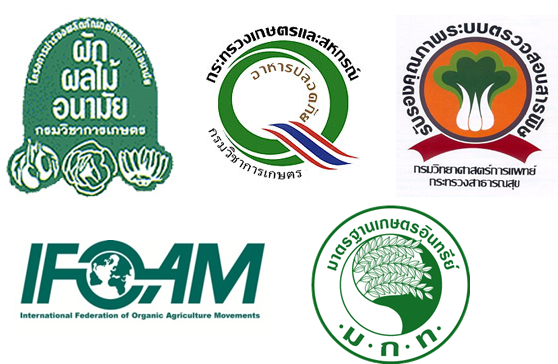
Problems began to emerge on policy implementation level. One of the biggest issues existed within Thai government bureaucracy is lack of coordination between organizations. The policy of spreading responsibility to local administrative offices creates a number of non-recognized accreditation offices whose knowledge corpus on organic agriculture is not up to international standards. Occasionally, random checks conducted by Ministry of Agriculture and Cooperatives and Ministry of Public Health found the contaminated produce even though the samples were awarded local accredited certificates. In 2008, Schobesberger.et.al investigated the issue of ‘Consumer perceptions of organic foods in Bangkok, Thailand’ and found…
Of numerous agriculture certificates existed in Thailand, only ‘hygenic food’ is known by more than half of the respondents; others are virtually non-existence in their directory. It’s also of noted that despite numerous certificates, half of the people who know about any of them are those who have previously bought organic products; in this case, they are those with stable financial capability, high education, and children in the family. Despite their recognition, very few of them can clearly indicate detail of how those certificates symbolize food safety or how they are different from the others.
The survey further indicated that 80% of respondents believe any product certificate with the word ‘organic’ is therefore organic-certified by international recognized standards. It is entirely an incorrected belief. To make it worse, roughly 50% of respondents think ‘Hygienic Food’ and ‘Pesticide Safe’ certificates are certificates for certified organic products. This is the same group of people who admit to not knowing enough about organic agriculture.
Three main reasons for buying organic agriculture are; 1) health 2) in-trend 3) tasty fruits and vegetable.
In 2005, certified produce such as ‘Hygienic Food’ was about 50% more expensive than conventional produce, but it was still way cheaper than organic produce which was about 50% (lettuce) to 400% (small hot chilies). The standard price for most organic produce (e.g. broccoli, eggplant, beans, kale, and cucumber) was between 100–170%. The vast difference in price between two product types and consumers’ lack of knowledge to differentiate them made the consumers confused. It also hindered growth of organic market in Thailand.
Without appropriate market channel for organic produce, organic farmers have no choice but to supply them to conventional market which appraising them with the same standards as conventional fruits and vegetable. Compound the problem with the fact that organic agriculture requires more labour force and generally yields lower volume products than conventional agriculture; it results in net loss and forces farmers to abandon organic practice.
One of the ways out for farmers is to participate in Royal Projects or signing contracts with modern supply chain companies such as Top Organic Co Ltd, River Kwae International Food Industry Co Ltd, Lemon Farm Cooperative, etc. These companies are moving in to enter Thailand agriculture sector and are willing to give farmers higher price per unit so long as farmers can abide by their conditions.
Share this post
Share on facebook
Share on google
Share on twitter
Share on linkedin
Share on pinterest
Share on print
Share on email